
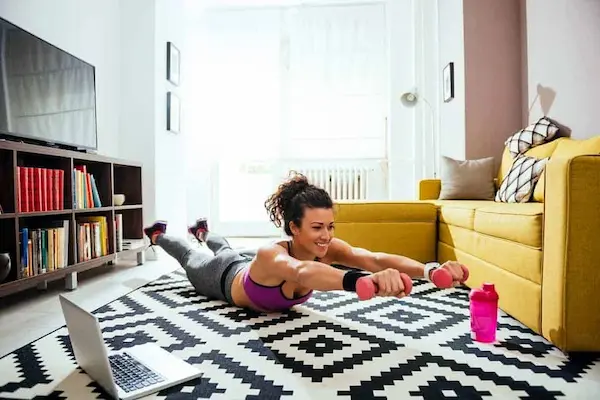
Plenty of people want to move more but feel blocked by the reality of a tiny apartment, thin walls, and neighbors who hear almost everything, so it can seem as if effective exercise is impossible without a big living room or a ground-floor home where jumping and running will not upset anyone.
Fortunately, many thoughtful workout ways for small spaces use slow, controlled, low-noise movements that can be done inside a rectangle no larger than a yoga mat, which means that even a studio with limited space and furniture pushed close together can still become a compact workout corner that supports strength, mobility, and a little bit of cardio without heavy impact.
Careful planning, creative exercise choices, and an emphasis on no jumping and low-impact options allow you to train quietly while respecting neighbors below and beside you, and once the apartment layout is set up properly, short sessions become far easier to start because the environment no longer feels like a barrier.
This guide introduces space-saving exercises, low-noise ways to move, compact workout circuits that fit in a tiny apartment, and layout tips that help you arrange furniture and floor space so that training feels safe, practical, and considerate of everyone living nearby.
Preparing Your Tiny Apartment for a Compact Workout

Step-by-Step Space Check Before You Start Moving
- Measure your training area roughly
- Stand where you think you will exercise, stretch your arms out to the sides, and gently rotate your body to see whether your hands touch walls, furniture, or shelves.
- A rectangle about the size of a yoga mat (roughly the length of your body and one mat width) is enough for nearly all workout ways for small spaces covered in this guide.
- Shift small furniture pieces if possible
- Push light chairs, small tables, or laundry baskets into corners so that the central area of the room stays clear, even if the free area is only a narrow strip.
- Use rolling items like office chairs with brakes locked or moved aside to avoid unwanted sliding during moves.
- Secure anything that might wobble
- Check that bookshelves, mirrors, or tall lamps are stable and not in danger of tipping if you brush against them during arm movements.
- Place breakable objects away from the training zone, especially on surfaces like coffee tables that you might use for balance.
- Create a simple “exercise kit” nearby
- Keep a mat or folded blanket, a small towel, and a water bottle in a specific corner so that setting up does not involve searching through cupboards first.
- If the floor is hardwood or tile, a non-slip mat reduces noise and joint impact while also stopping feet from sliding during standing work.
Noise and Neighbor Considerations
- Gravity-heavy moves such as jumping jacks or burpees create loud thumps, so no jumping options, slow steps, and controlled transitions become the main focus when designing workout ways for small spaces.
- Working out during daytime hours, especially early evening, usually keeps noise less disruptive; late-night sessions are better built from extra-soft exercises such as floor mobility, stretching, and slow strength work.
- A thick rug, interlocking foam tiles, or a folded mat under your main training area absorbs sound and protects floors, which can be particularly helpful if a tiny apartment sits above someone else’s bedroom or office.
- Music through headphones instead of speakers keeps sound inside your own space and avoids broadcasting your compact workout soundtrack through the walls.
Warm-Up Ideas That Stay in One Spot and Make No Noise
Five-Minute Standing Warm-Up for Limited Space
- Neck and shoulder reset (about 1 minute)
- Stand tall, gently tilt your head side to side and turn to look over each shoulder, keeping movements slow and within a comfortable range.
- Circle your shoulders forward ten times and backward ten times, letting tension leave gradually.
- Arm swings and torso wake-up (about 1 minute)
- Swing arms gently forward and backward, staying aware of nearby walls to avoid contact, then cross them in front of your chest and open wide in smooth repetitions.
- Add a few controlled torso rotations by turning your ribcage left and right while hips stay facing forward.
- Hip and knee preparation (about 2 minutes)
- Hold a wall or the back of a chair and perform small hip circles with one leg, then repeat on the other side, staying steady through the rest of your body.
- Bend each knee gently a few times, as if beginning a shallow squat, then straighten again, noticing how knees feel in this very limited motion.
- Quiet marching or heel raises (about 1 minute)
- March in place with soft footfalls, lifting feet only slightly to reduce noise while still increasing circulation.
- Alternate marching with controlled heel raises, rising slowly onto the balls of your feet and lowering again without letting heels slam onto the floor.
Seated Warm-Up for Even Tighter Corners
- When standing space is extremely limited, a chair warm-up can be just as effective:
- Sit upright, circle ankles and wrists, then gently lift one knee at a time in a marching pattern while keeping toes relaxed.
- Reach arms overhead and lower them to shoulder height, repeat slow presses upward, and finish with small torso twists while hips stay grounded on the seat.
Space-Saving Standing Exercises With No Jumping
Compact Lower-Body Strength Moves
- Half or full squats in a narrow footprint
- Position feet about hip-width apart, stand between two pieces of furniture or near a wall to limit side-to-side movement, and sit your hips back while bending your knees to a comfortable depth.
- Press through your heels to stand up again, avoid bouncing, and keep your torso stable so the movement stays entirely vertical, minimizing noise and required space.
- Perform 8–12 repetitions for two or three simple sets, resting quietly between rounds.
- Reverse lunges or mini step-backs
- Start with feet close together, take a short step backward with one foot while bending both knees slightly, then return to the starting position without stamping the foot down.
- Use a counter or chair for balance if needed, and avoid very long steps, since compact workout ways for small spaces favor shorter ranges that fit inside a mat-sized box.
- Alternate legs for 6–10 repetitions each, staying focused on quiet landings and controlled body alignment.
- Wall-supported calf raises
- Stand near a wall with your fingertips resting lightly on it, lift heels slowly, pause for a moment at the top, and lower them gently so no heavy thud reaches the neighbors below.
- Repeat 12–15 times, concentrating on moving in a straight up-and-down line in the small area you have.
Compact Upper-Body Strength Moves
- Wall push-ups in a small rectangle
- Place hands on a wall at chest height and slightly wider than shoulder-width, step back until your body is at a slight angle, and lower your chest toward the wall before pushing back out.
- Because feet stay planted and the motion involves only quiet arm and upper-body movement, this variation fits well in a tiny apartment and creates virtually no impact noise.
- Complete 8–12 repetitions, then rest and repeat for one or two simple sets.
- Incline push-ups on a sturdy surface
- Use a heavy desk, kitchen counter, or solid table as a base for incline work, placing hands on the edge, walking feet back, and performing slow push-ups with full control.
- Check that the furniture does not slide by testing gently before you begin, especially in a limited space where falling would be more likely to contact nearby objects.
- Door-frame isometric holds
- Stand in a doorway, press your forearms gently against the sides, and hold the tension for 10–20 seconds while breathing steadily to engage chest and shoulder muscles without movement or sound.
- Release slowly, rest, and repeat for a low-noise strength stimulus that requires zero extra room.
Seated and Floor Exercises for Very Tight Rooms
Seated Strength and Mobility in a Tiny Apartment
- Seated knee extensions
- Sit upright on a stable chair, extend one lower leg until it becomes parallel with the floor or as far as is comfortable, squeeze the thigh for a second, and lower again without letting your foot slam down.
- Alternate legs for 8–12 repetitions each in a quiet, controlled compact workout.
- Seated overhead press with no equipment
- Raise arms to shoulder height and press them upward toward the ceiling with open hands, as if pushing a light surface away, then lower slowly again.
- 10–15 repetitions offer a simple, noise-free way to challenge shoulders in limited space.
- Torso rotations on a chair
- Cross your arms over your chest or hold them lightly in front, then rotate your upper body to one side and then the other while hips stay facing forward.
- Keep the movement small and smooth to avoid bumping into nearby objects, and repeat 8–10 times per side.
Floor Core and Mobility Work on a Single Mat
- Glute bridges
- Lie on your back on a mat with knees bent, feet flat, and arms by your sides, then lift your hips until a straight line forms from shoulders to knees, pause, and lower gently.
- All motion stays vertical and close to the floor, making this a perfect low-noise option in a small apartment.
- Dead-bug core pattern
- Lie on your back, raise arms toward the ceiling, and lift legs to 90 degrees at hips and knees, then slowly lower one arm and the opposite leg toward the floor before returning and switching sides.
- Because this technique-based move stays on a mat, it fits easily into any workout ways for small spaces while training coordination and central stability.
- Cat-cow spine mobility
- Position yourself on hands and knees within the footprint of the mat, round your spine gently upward, then slowly reverse into a mild arch, staying comfortable and smooth.
- Repeat 8–12 times to relieve stiffness from desk work or couch time.
Low-Noise Compact Workout Circuits for Small Spaces
10-Minute Quiet Strength Circuit
For days when time is short and noise must stay minimal, a concise circuit built entirely from slow, controlled exercises fits very well into a limited space.
- Chair squats – 10 repetitions.
- Wall push-ups – 8–10 repetitions.
- Seated knee extensions – 8 repetitions each leg.
- Glute bridges – 10–12 repetitions.
- Complete all four moves in sequence, rest quietly for 60–90 seconds, then repeat the circuit one or two more times depending on energy levels.
- All movements stay within the footprint of a single mat or even a chair plus a small floor patch, making this truly one of the simplest workout ways for small spaces.
15-Minute Tiny Apartment Strength and Mobility Session
- Warm-up (3 minutes): Neck and shoulder circles, gentle marching, and a few hip circles done in one spot.
- Main block (10 minutes):
- Half squats – 12 repetitions.
- Incline push-ups on counter – 8–10 repetitions.
- Dead-bug core drill – 6–8 repetitions per side.
- Standing calf raises – 12–15 repetitions.
- Repeat the set two times, taking quiet breaks between rounds and minimizing stomping or quick transitions.
- Cool-down (2 minutes): Gentle hamstring, chest, and shoulder stretching, all within the same compact area.
20-Minute No Jumping Compact Workout
When more time is available, a slightly longer routine still respecting neighbors can provide a comprehensive session without extra noise.
- Warm-up (5 minutes)
- Standing mobility for neck, shoulders, hips, and ankles, followed by quiet marching.
- Strength block 1 (7 minutes)
- Chair squats – 10–12 repetitions.
- Wall push-ups – 10–12 repetitions.
- Glute bridges – 12–15 repetitions.
- Repeat block once, breathing steadily and staying aware of form.
- Strength block 2 (5 minutes)
- Reverse lunges or mini step-backs – 8 repetitions each leg.
- Seated or standing torso twists – 10 repetitions per side.
- Incline plank on counter or table – 15–20 seconds hold, repeated twice.
- Cool-down (3 minutes)
- Slow stretches within the mat footprint, plus a few deeper breaths to end the session.
These carefully chosen blocks use no jumping and prioritize smooth transitions so that neighbors hear little more than faint footfalls and occasional floor creaks.
Layout Ideas: Designing a Functional Training Corner in Limited Space
One-Mat Workout Layout
- Place a mat lengthwise in the largest clear area, even if that space sits between a couch and coffee table with only a narrow strip available; many bodyweight moves only require the length of your body.
- Reserve one long side of the mat as the “standing line,” where you perform squats, lunges, calf raises, and wall work, and use the center of the mat for floor exercises like glute bridges and core training.
- Keep a sturdy chair at the head or foot of the mat to serve as a support point for balance and seated movements without pulling out new furniture each time.
Micro-Corner Setup for Extremely Tiny Apartments
- Create a triangle of space between the bed, a dresser, and the wall, then stand or sit facing the open angle; this micro-corner can host most stationary exercises such as wall push-ups, squats, and seated drills.
- For floor work in a tight triangular zone, position yourself diagonally so your head points toward one corner and feet toward another, which often fits better than aligning with the walls.
- Use vertical space creatively by incorporating wall-based moves—like wall slides, isometric holds, and incline planks—that do not require much horizontal room.
Furniture-Friendly Compact Workout Choices
- Sofas and sturdy beds can act as incline surfaces for push-ups or hip bridges, though testing stability beforehand is essential to avoid sliding.
- Low tables or ottomans sometimes serve as step-up platforms in no-jumping routines, provided they are heavy enough not to tip and you step quietly onto the surface.
- The back of a dining chair or heavy stool simplifies balance exercises and one-leg work within very limited space.
Progression and Rest in Small-Space Training
How to Progress Quietly Without Breaking Form
- Increase repetitions slowly, adding one or two reps per set every week or two as long as movements remain smooth and knees, hips, shoulders, and back feel comfortable after training.
- When simple sets feel easy, slow the tempo instead of introducing loud or jumping movements; for example, take three seconds to lower into a squat and two seconds to stand up again.
- Reduce reliance on furniture support during certain moves over time, such as transitioning from two-hand support on the counter to one hand, then to fingertips, while still staying ready to grab solid support instantly if balance wavers.
Rest, Recovery, and Weekly Planning in Tiny Apartments
- Full-body routines done two or three times per week usually leave enough time for recovery, while shorter mobility or stretching sessions on other days keep your body moving gently without overtaxing muscles.
- Quality sleep and hydration matter as much in compact workout contexts as in any other training environment, so paying attention to those basics helps your body adapt to steady strength work.
- A simple weekly plan might include one 10-minute circuit on busy days and a 20-minute routine on quieter days, all in the same small corner, to build consistency without overwhelming your schedule.
Adapting for Different Levels and Respecting Limits
Modifications for Joint Sensitivity or New Exercisers
- Shallow squats, supported lunges, and very short hold times for planks give joints time to adapt and reduce stress compared with deep angles or long static holds.
- Combining standing and seated moves allows hips and knees to rest while still training different muscle groups, which can be especially helpful for people just starting or returning after a long break.
- Reducing total duration—perhaps starting with 5–8 minutes on the first few days—proves that movement is possible even in a limited space without demanding too much too soon.
Signs to Slow Down or Seek Professional Advice
- Sharp pain, persistent discomfort, or worsening joint symptoms deserve attention from a health professional rather than continued self-directed training in any environment, including a small apartment.
- Dizziness, chest discomfort, or unusually strong shortness of breath are signals to stop immediately, rest, and get medical help if those sensations do not pass quickly.
- Uncertainty about whether a particular exercise is safe after surgery, injury, or medical diagnosis should be addressed with a doctor, physical therapist, or other qualified professional before you attempt that movement at home.
Putting It All Together: Quiet Strength in a Small, Neighbor-Friendly Space
A cramped studio, thin floors, or close neighbors do not automatically prevent you from building strength, mobility, and stamina at home, because carefully chosen workout ways for small spaces focus on controlled, low-impact, no-jumping movements that stay within a mat-sized footprint while still challenging muscles and improving overall fitness.
By rearranging furniture a little, keeping an organized training corner, and relying on compact workouts that emphasize slow squats, wall push-ups, seated drills, and quiet core work, you can move more often without worrying that every step echoes through the building or that you need to join a gym.
Over time, these low-noise routines create both physical and mental benefits: muscles become more resilient, joints feel more comfortable, posture improves during long hours at a desk or on the couch, and confidence grows as you realize that a tiny apartment and limited space are no longer obstacles to regular exercise.
With creativity, respect for your own limits, and consideration for neighbors, simple bodyweight sessions completed in a small footprint can form a powerful foundation for long-term health and strength, proving that effective training does not require a big room, just thoughtful workout ways for small spaces and a decision to use the room you already have.