
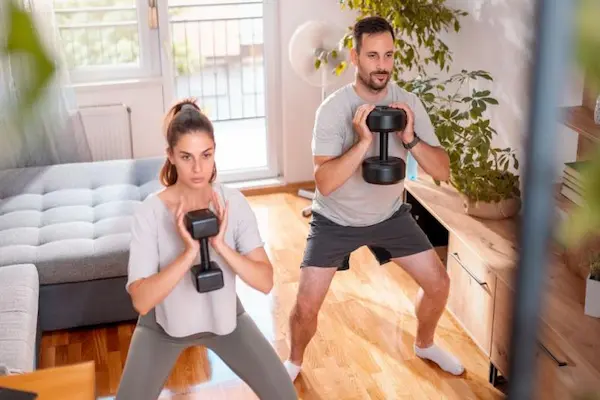
Designing full body workout ways at home gives you a simple, structured blueprint for moving your whole body without needing a gym membership or expensive gear.
Instead of wondering which muscle to train on which day, you can perform one balanced workout that touches upper body, lower body, core, and a little bit of cardio in the same session.
For an intermediate beginner who has tried a few basic exercises and now wants more organized sessions, this approach brings clarity and confidence to home training.
Because every major area gets some attention, a full body routine makes it easier to stay consistent even if life occasionally forces you to miss a day.
Working out this way at home also respects your time, since one well planned session can support strength and cardio together, instead of splitting them into separate workouts.
Another advantage is that you can scale each movement up or down, choosing gentler or more intense versions depending on your energy and experience on that specific day.
As you read through this article, you will discover structured examples of balanced workout sessions, clear warm up and cool down guidance, and practical progression suggestions to keep improving safely.
All explanations use everyday language so you can start applying them immediately in your living room, bedroom, or any corner where you have a bit of free space.
Why full body workout ways at home are so effective

A well designed full body routine respects how your body prefers to move in real life, using multiple joints and muscles together rather than isolating one small area at a time.
Daily activities like lifting bags, climbing stairs, or playing with children rarely involve a single muscle group, so training compound patterns at home prepares you for those tasks more directly.
Because full body workout ways at home combine upper body, lower body, core, and strength and cardio elements, they create a strong training stimulus even with simple equipment or no equipment at all.
Including pushing, pulling, squatting, hinging, rotating, and bracing patterns in one session encourages balanced workout development instead of overemphasizing only one area such as arms or abs.
From a motivation perspective, many people enjoy the sense of completeness that comes from finishing one session and knowing every part of the body has contributed.
There is also a recovery advantage, since moderate sets for each region allow you to train full body several times per week without overwhelming any single joint or muscle group.
For an intermediate beginner, this structure makes progression easier to understand, because you can add sets, refine technique, or increase intensity bit by bit across familiar patterns.
Ultimately, combining strength and cardio within a full body routine at home builds a foundation that supports both health and performance in a sustainable way.
Key benefits of a balanced full body routine
Before diving into specific exercises, it helps to see the main benefits that a balanced workout plan can offer when done consistently at home.
Understanding these advantages makes it easier to stay committed during busy weeks and low energy days.
- Time efficiency, because a single session covers multiple goals such as strength and cardio, mobility, and core stability.
- Better overall balance between upper and lower body, so one region does not dominate or lag behind the others.
- Improved calorie burn over the day thanks to large muscle groups working together in repeated, compound movements.
- Increased independence, since full body workout ways at home free you from gym schedules or crowded equipment.
- Simple weekly planning, where you can repeat similar structures two or three times and still feel that your training is complete.
- Flexible intensity options, allowing you to keep the exercises but adjust tempo, range of motion, or rest periods as you gain experience.
With these benefits in mind, it becomes easier to treat your home training time as an important appointment with yourself instead of a negotiable extra.
Preparing your space and mindset for home training
Balanced home training does not demand a dedicated studio, yet a bit of preparation for your environment and your mindset goes a long way toward making each session smoother.
Choosing a small area where you can fully stand, step forward, step back, and lie down without hitting furniture will make full body workout ways at home feel much more comfortable.
Clearing that space of clutter before sessions signals to your brain that it is time to focus on movement rather than everyday distractions.
Since many full body routines use only bodyweight or light objects, equipment needs stay minimal and storage is rarely a problem.
Below is a practical checklist you can use as a quick setup ritual before each home training session.
- Choose a non slippery surface such as a mat, rug, or carpet where your feet will not slide.
- Move small tables, cables, or toys out of the way so your path remains open in all directions.
- Keep a sturdy chair nearby for support, modifications, or certain exercises that require elevation.
- Place a bottle of water and a small towel within reach so you do not need to pause the flow of your routine.
- Silence notifications on your phone or set it to “do not disturb” for the duration of the workout.
Once these details feel automatic, your brain has more energy available for focusing on technique, breathing, and intensity options instead of logistics.
Warm up foundations for a balanced workout at home
Starting a session with a clear warm up sequence prepares joints, muscles, and nerves for the full body routine that follows, especially when strength and cardio moves will appear in the same workout.
A good warm up raises body temperature, gently increases heart rate, and rehearses the main movement patterns you will be using in your strength and cardio blocks.
Intermediate beginners often feel tempted to skip this step to save time, yet only a few focused minutes can dramatically improve how the main sets feel.
Rather than thinking of warm ups as something separate, you can treat them as the first, lighter round of your home training structure.
Simple five minute warm up sequence
The following sequence uses no equipment and can be done in a very small space.
It is designed to support full body workout ways at home by activating all major areas without exhausting you before the main routine.
- March in place for sixty seconds
Lift your knees lightly, swing your arms comfortably, and keep breathing steady as you start waking up your cardiovascular system.
- Arm circles for thirty seconds each direction
Draw slow circles forward with both arms, then reverse the direction, keeping shoulders relaxed and chest open.
- Hip circles and gentle hinges for ninety seconds
Rotate your hips in both directions, then practice bending forward with a long spine, placing hands on thighs or shins according to your mobility.
- Bodyweight squats for sixty seconds
Lower into a comfortable squat, reach your arms forward for balance, and stand up while pressing through your heels without rushing.
- Wall or chair push ups for sixty seconds
Place your hands on a wall or back of a chair, walk your feet back slightly, and perform slow push ups to warm your chest and arms.
After completing this sequence, your body should feel warmer, more awake, and ready to handle the demands of a balanced workout without feeling stiff or surprised.
Full body routine: strength and cardio circuit for intermediate beginners
Once your body feels prepared, a structured full body routine built around circuits will allow you to train several qualities at once while staying engaged from start to finish.
The following example focuses on accessible movements that combine strength and cardio in a smooth, progressive way suitable for intermediate beginners training at home.
Each exercise includes intensity options so you can adapt the full body workout ways at home to match your current energy, experience, and comfort level.
Structure of the circuit
This circuit includes six exercises that collectively train lower body, upper body, core, and cardiovascular endurance.
You can work with time based intervals or repetition targets depending on whether you prefer to watch a clock or count reps.
- Perform each exercise for forty seconds followed by twenty seconds of rest, then move to the next movement.
- After finishing all six exercises, rest for one or two minutes before starting the next round.
- Complete two rounds if you are newer to circuits and gradually progress toward three or four rounds over several weeks.
Exercise list for the circuit
- Squat to reach
Lower into a comfortable bodyweight squat, then stand up and reach your arms overhead as if placing something on a high shelf.
For a gentler option, keep the squat shallow and move more slowly, while for a stronger challenge you can add a small calf raise at the top.
- Incline push ups
Place your hands on a chair or sturdy table, walk your feet back, and perform controlled push ups with a straight line from shoulders to heels.
Reducing the angle by using a lower surface or eventually moving to the floor increases intensity, while stepping closer softens the load.
- Reverse lunges in place
Step one foot back, lower your back knee toward the floor, then return to standing and switch legs, keeping your chest upright.
Holding on to a wall or chair offers balance support, and limiting the depth of the lunge makes the exercise more accessible.
- Rowing motion with bands or towels
If you own a resistance band, loop it around a stable anchor and pull toward your ribs; otherwise, brace a towel around a doorknob and lean back slightly as you row.
Engage your back muscles by imagining your shoulder blades sliding toward each other every time you pull.
- Standing core rotations
Stand with feet wider than hips, hold your hands together in front of your chest, and rotate your torso gently side to side.
Increase intensity by holding a light object, such as a water bottle, and slightly bending your knees into an athletic stance.
- Low impact cardio step or march
Finish the circuit with marching in place, side steps, or stepping on and off a low sturdy platform, keeping your arms moving.
Adjust speed to match a moderate breathing challenge where you can still speak in short sentences but feel you are working.
Running through this circuit creates a true full body routine that blends strength and cardio, and repeating it regularly will improve coordination, stamina, and confidence in home training.
Intermediate full body routine with strength and cardio blocks
After you feel comfortable with the previous circuit, you might enjoy a more structured session that separates strength and cardio into distinct blocks while still keeping the workout balanced.
This second example uses slightly longer strength sets and short, focused cardio bursts to challenge your body in another way while maintaining full body workout ways at home.
Block one: lower body strength focus
The first block emphasizes legs and hips, providing a foundation for power and stability before upper body and cardio elements appear.
- Romanian deadlifts with backpack
Hold a loaded backpack or bag in front of your thighs, hinge at your hips with a long spine, then stand tall while squeezing your glutes.
Complete three sets of ten to twelve repetitions, resting forty five seconds between sets.
- Split squats
Position one foot forward and one foot back, bend both knees to lower your body, and push through the front heel to rise.
Perform eight to ten repetitions per leg for two or three sets, using a chair or wall lightly for balance if needed.
Block two: upper body strength and posture
Next, attention shifts to chest, back, and shoulders through a pair of simple yet effective movements.
- Push ups at your chosen level
Use the floor, a low table, or a wall to perform three sets of eight to twelve push ups, keeping elbows slightly tucked and core engaged.
- Bent over rows
Hinge forward with a neutral spine, hold two water bottles or other small weights, and pull them toward your ribs, squeezing your back muscles.
Work for three sets of ten to twelve repetitions, matching your rest periods to how challenging the load feels.
Block three: core and short cardio bursts
The final block blends core stability and brief bouts of cardio to complete your balanced workout.
- Plank variations
Hold a plank on hands or forearms for twenty to thirty seconds, rest, and repeat two or three times, focusing on a straight line from shoulders to ankles or knees.
- High knee march or light jog in place
Perform thirty to sixty seconds of marching or gentle jogging in place, using arm swings to raise intensity while monitoring your breathing.
By stacking these blocks together, you create a full body routine that feels organized and purposeful, helping you notice progress from week to week as strength and cardio capacity expand.
Cool down and recovery after home training
Ending your session with a short cool down protects your body from abrupt transitions and supports better recovery between workouts.
Instead of stopping suddenly after the last repetition, taking a few mindful minutes to lower your heart rate and stretch gently can make a noticeable difference in how you feel the next day.
Three step cool down structure
The cool down can stay simple while still covering breathing, mobility, and relaxation.
- Gradual heart rate lowering
Walk slowly around the room or march lightly in place for one to two minutes, allowing your breathing to return toward normal.
- Targeted stretches
Hold gentle stretches for calves, thighs, chest, and shoulders for twenty to thirty seconds each, keeping discomfort away from sharp or painful sensations.
- Calming breaths
Finish with five to ten deep breaths, inhaling through the nose and exhaling through the mouth while you stand or sit comfortably.
Short cool downs like this one help signal that the balanced workout is complete, giving both body and mind a chance to shift back into everyday mode with a sense of closure.
Progression suggestions to evolve your full body routine
Improvement happens when your body receives a slightly stronger challenge than it is already used to, so progression is a key element of full body workout ways at home.
Progress does not always mean adding more weight or moving faster; many subtle options allow you to continue growing without overwhelming your joints or schedule.
Common progression levers
Several variables can be adjusted one at a time to keep your full body routine productive for many months.
- Increasing repetitions slowly, such as moving from eight to ten and then twelve repetitions per set before raising difficulty further.
- Adding another round to a circuit, turning two rounds into three once the original plan feels solid and sustainable.
- Reducing rest periods by ten to fifteen seconds to nudge cardiovascular demand higher without changing the movements.
- Exploring slightly deeper ranges of motion, like squatting a little lower or hinging a bit further while maintaining good technique.
- Upgrading leverage, for example moving from wall push ups to incline push ups and eventually toward floor variations.
Step by step progression roadmap
To make these ideas practical, here is a four step roadmap you can follow over several weeks or months.
- First, choose one full body routine structure and repeat it consistently for at least two or three weeks without major changes.
- Next, track how many repetitions or rounds feel comfortable, and note any movements that still feel confusing or unstable.
- Then, apply a single progression lever, such as adding a third round or increasing each set by two repetitions, and stay there until it feels manageable.
- Finally, once that adjustment feels familiar, consider modifying one or two exercises to a slightly more advanced version while keeping the overall layout similar.
Moving gradually like this makes home training feel more like an unfolding journey than a constant struggle, and it supports steady gains instead of exhausting spikes of effort.
Putting full body workout ways at home into your week
Balanced training depends not only on what you do inside a single workout, but also on how those sessions fit into your week as a whole.
Even for an intermediate beginner, there is no need for daily intense workouts; two to four full body sessions can be enough when designed thoughtfully.
Example weekly schedules
The following sample structures show how you might organize your full body routine, warm ups, and cool downs around real life responsibilities.
- Option one: three day plan – full body workouts on Monday, Wednesday, and Friday, with active rest such as walking or light stretching on other days.
- Option two: two day plan – full body sessions on Tuesday and Saturday, leaving plenty of recovery space for busy weeks.
- Option three: four shorter sessions – slightly shorter full body workout ways at home on Monday, Tuesday, Thursday, and Friday when you prefer brief but frequent movement.
Rest days do not need to be completely inactive, and many people enjoy gentle mobility, easy walks, or playful movement that keeps the body limber without feeling like formal training.
The most important element is choosing a weekly rhythm that feels realistic and sustainable rather than trying to copy the schedule of someone with a different lifestyle or training history.
Mindset tips to stay motivated with home training
Even a well designed plan only works when you follow it often enough, so mindset and motivation play a huge role in full body workout ways at home.
Intermediate beginners sometimes feel caught between simple beginner routines and more advanced programs, which can create doubt about whether their efforts are “enough.”
Instead of chasing perfection, treating each completed balanced workout as a small promise kept to yourself helps build internal trust and long term commitment.
Practical motivation strategies
The ideas below can help keep your sessions regular and enjoyable.
- Schedule your full body routine in your calendar like any other important appointment, including reminders.
- Prepare your training space and comfortable clothes in advance so starting requires fewer decisions.
- Use a simple notebook or digital note to record each workout, marking sets, repetitions, or how you felt afterward.
- Celebrate small progression milestones, such as your first set of twelve push ups at a certain level or an extra round of your circuit.
- Allow yourself flexible intensity days, where you still show up but choose gentler variations when energy is low.
Motivation naturally rises and falls, yet a clear structure, visible progress, and a kind attitude toward yourself make it much easier to come back consistently.
Important safety notes, autonomy, and independence notice
All the full body workout ways at home described in this article are general suggestions and cannot replace personalized medical advice, physical therapy, or one on one coaching.
If you have any existing health conditions, injuries, unexplained pain, or concerns about starting or progressing a full body routine, it is essential to consult a qualified health or fitness professional before making changes.
During every warm up, main strength and cardio block, and cool down, listening to your own body remains the most important safety tool you possess.
Any movement that produces sharp pain, intense dizziness, chest discomfort, or unusual symptoms should be stopped immediately, with professional help sought if needed.
Exercises, intensities, and schedules must always be adapted to your personal level, and skipping or modifying a movement that feels risky is a sign of wisdom, not failure.
This content is independent and does not have any affiliation, sponsorship, endorsement, or control from institutions, platforms, brands, or other third parties that may be mentioned in a general or descriptive way.
Names of products, tools, or examples are used only to illustrate home training ideas, without any official relationship or responsibility shared with them.
Your body, your space, and your pace remain central throughout, and the purpose of these balanced workout suggestions is to support your autonomy and well being rather than to replace professional judgment or your own common sense.