
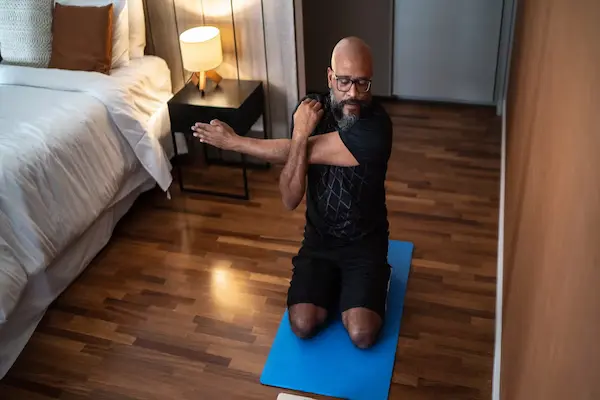
As the day ends, many people notice that instead of feeling calm and sleepy, their shoulders are tight, their thoughts are racing, and their body seems stuck in a “busy” mode that refuses to switch off.
Long hours of sitting, constant notifications, and emotional pressure all leave traces in your muscles, your breathing, and your posture, which is why evenings often bring stiffness, tension, and a heavy feeling in the neck, back, or jaw.
Gentle evening fitness habits to relax the body are not about intense effort or pushing harder; they are about giving your nervous system a clear, kind message that the day is closing and it is safe to slow down, soften, and release.
By choosing a simple nighttime routine that combines light activity, stretching, and slow breathing, you create a personal bridge between your busy hours and your rest, so your body and mind do not have to make that jump all at once.
This article will guide you through easy movements, calming sequences, and realistic examples that help you relax body and mind in a way that feels soothing rather than demanding.
Why Evenings Often Feel More Tense Than Calm

During the day, your body quietly absorbs small stresses such as rushing to answer messages, sitting in awkward positions, and thinking through problems, and all of that tension builds up like a slow background noise inside your muscles.
By the time night arrives, you may finally stop moving physically, yet your inner state is still wired, and this mismatch between a still body and an active mind can create restlessness, tightness, and difficulty settling into sleep.
Without any intentional transition, your brain continues to believe it must stay alert, which keeps your breathing shallow, your heart rate slightly elevated, and your muscles on standby instead of entering a truly relaxed mode.
Introducing evening fitness habits to relax acts like a gentle signal that the demands of the day are fading, so the body can safely move from “do and protect” into “restore and recover.”
How Gentle Nighttime Movement Helps You Let Go
Light activity that is slow, rhythmic, and predictable can calm your nervous system because your brain receives repeated signs that nothing threatening is happening and it is acceptable to loosen control.
Stretching gently increases blood flow, releases built up stiffness, and helps you become aware of where you are holding tension, making it easier to soften and adjust your posture.
When you combine stretching with a calm nighttime routine and relaxed breathing, your body shifts from a stressed state toward a more peaceful feeling, and this makes falling asleep and staying asleep far more natural.
Instead of forcing relaxation, these evening fitness habits to relax create the conditions where comfort arises gradually and feels safe, especially for a person who arrives at night feeling tense or overwhelmed.
Principles for Soothing Evening Fitness Habits to Relax
Slow Movements and Soft Effort
Calming evening practices are very different from intense training sessions because the goal is not to challenge your limits, but to send your body steady, reassuring signals of safety.
Movements should feel smooth, unhurried, and comfortable, with no jolting, bouncing, or pushing into sharp discomfort, so your muscles can release rather than brace.
Choosing light activity that keeps your breathing easy and even allows your heart rate to stay in a comfortable range where relaxation is still possible.
When you follow this kind of nighttime routine, you are teaching your body that movement and rest can be friends, not opposites.
Breath as the Anchor of Your Nighttime Routine
Breathing patterns directly influence the nervous system, so slower, deeper breaths can gently calm your inner state, especially when paired with stretching or quiet movement.
Allowing the exhale to last slightly longer than the inhale is a simple way to tell your body that danger has passed and that it can release its constant readiness to react.
Combining breath awareness with evening fitness habits to relax gives you a powerful yet soft anchor that can be used anywhere, even on nights when you feel especially agitated.
Over time, your brain begins to associate these breathing patterns with comfort, making it easier to unwind as soon as you begin your routine.
Comfort, Safety, and Warmth First
Feeling physically comfortable is essential when you are trying to relax body and mind, which means your environment matters as much as your movements.
Soft lighting, warm clothing or a blanket nearby, and a quiet space where you will not be interrupted all help your nervous system lower its guard.
Using supportive pillows or cushions under your knees, hips, or back during stretching can prevent strain and make gentle positions easier to hold.
When the body senses warmth, softness, and safety, evening fitness habits to relax can work more deeply without requiring intense effort.
Easy Full-Body Stretching Sequence to Unwind
Preparing for Your Evening Stretching Practice
Before starting your nighttime routine, it helps to choose a small, calm area with enough floor space for you to lie down or move your arms freely without bumping into furniture.
Placing a yoga mat, a folded blanket, or even a comfortable rug on the floor gives you cushioning that protects your joints and encourages you to stay with each stretch for longer.
Wearing soft clothes that do not pinch or restrict your breathing allows your body to move and expand gently as you stretch.
It can also feel soothing to dim the lights slightly or use a warm lamp, because bright lighting can keep your brain in daytime work mode.
Step-by-Step Evening Stretching Sequence
The following sequence is designed as an easy way to relax body and mind from head to toe, with simple movements that most people can adapt to their comfort level.
You can move through each step slowly, keeping your breathing relaxed and your awareness focused on how your body feels from moment to moment.
- Neck and Shoulder Release
Sit or stand with your spine tall, then let one ear gently move toward your shoulder while keeping both shoulders relaxed and heavy.
Hold the position for several slow breaths, feeling the side of your neck lengthen without forcing it, and then change to the other side with the same patience.
Finish by rolling your shoulders in slow circles forward and backward to melt away remaining tightness.
- Chest Opening Stretch
Interlace your fingers behind your back or hold a towel lightly between both hands, then gently lift your hands away from your body while keeping your shoulders soft and your chin slightly tucked.
Notice the front of your chest and shoulders opening after a day of curling forward over screens.
Breathe into the expanded space around your heart and upper ribs, imagining that each exhale carries stress away.
- Side Body Lengthening
Stand or sit tall, raise one arm overhead, and lean gently to the opposite side as if you are creating a long arc from your hip to your fingertips.
Feel the stretch along your ribs, waist, and outer hip, then take a few slow breaths before returning to center.
Repeat on the other side, allowing your body to sway in a calm, smooth motion rather than snapping into position.
- Cat and Cow Spine Flow
Move onto your hands and knees with your wrists under your shoulders and your knees under your hips, using a folded blanket if your knees are sensitive.
As you inhale, gently arch your back, lifting your chest and tailbone slightly while keeping your neck comfortable and soft.
On the exhale, round your spine, tucking your chin and tailbone softly, as if you are creating a gentle wave through your back.
Continue this slow rhythm for several breaths, letting tension melt from each vertebra.
- Hip Flexor and Front Thigh Stretch
Step one foot forward into a low lunge position, with your back knee resting on a cushion, and gently shift your weight forward until you feel a comfortable stretch in the front of your back hip and thigh.
Keep your chest lifted lightly and your shoulders relaxed so that the stretch feels stable rather than wobbly.
Hold for several breaths, then switch sides and repeat with patience, noticing any differences between your right and left hip.
- Hamstring and Calf Ease
Sit on the floor with one leg extended and the other comfortably bent, placing a strap or towel around the ball of your extended foot if reaching with your hands feels too intense.
Hinge gently from your hips and lean slightly forward over the straight leg until a mild stretch arises in the back of the thigh and calf.
Stay in that position for several breaths without pulling or bouncing, then repeat on the other side with the same gentle intention.
- Gentle Seated Twist
Sit cross legged or with legs extended if that is more comfortable, and place one hand on the opposite knee while your other hand rests behind you lightly for support.
On an inhale, lengthen your spine, and on an exhale, rotate gently toward the back hand without forcing your body to turn further than it wants to go.
Take several breaths here, then return to center slowly and repeat the twist on the other side.
- Child’s Pose for Deep Rest
From a kneeling position, sit back toward your heels, widen your knees if that feels better for your hips, and fold your torso forward, resting your forehead on the floor or a cushion.
Let your arms rest alongside your body or stretched forward, whichever feels more relaxing, and allow your back to broaden with each inhale.
Stay for a few minutes, noticing how this position helps your body release into the floor and your mind drift toward quiet.
This stretching sequence can be shortened on very tired evenings or extended on nights when you crave more time, yet even a few of these movements can make your evening fitness habits to relax feel complete.
Breathing Ideas to Calm the Nervous System at Night
Soft 4–6 Breathing to Relax Body and Mind
A simple breathing practice that many people find soothing at night is a gentle 4–6 pattern, where the inhale is counted to four and the exhale is counted to six.
Lengthening the exhale slightly signals to your nervous system that you are safe and no longer need to stay ready for action.
- Find a relaxed position, either seated with back support or lying down with a pillow under your knees for comfort.
- Place one hand on your belly and one hand on your chest to feel the movement of your breath without forcing anything to change at first.
- Gently inhale through your nose, counting slowly to four as your belly and ribs expand in a natural, unhurried way.
- Exhale through your nose or softly through your mouth, counting to six, letting your belly fall and your shoulders soften.
- Continue this pattern for five to ten rounds, or longer if it feels pleasant, always keeping the breath smooth and comfortable.
Adding this breathing practice to your nighttime routine turns your evening fitness habits to relax into a full body and breath experience rather than focusing only on muscles.
Gentle Box Breathing with Soft Edges
Box breathing is another method that can help calm an overactive mind, yet for evening use it is often helpful to keep the counts short and the effort very soft.
Instead of rigid control, you are aiming for a smooth, square rhythm that feels like rocking your nervous system into rest.
- Inhale slowly for a count of four while imagining air filling the lower part of your ribs.
- Hold your breath lightly for a count of four, without squeezing or tightening your throat.
- Exhale gently for a count of four, letting your jaw, chest, and shoulders melt.
- Pause softly after the exhale for a count of four, feeling the natural stillness before the next breath.
Repeat this pattern for several minutes, and if at any point it feels uncomfortable, shorten the counts or return to natural breathing until calm returns.
Combining Breath with Stretching and Light Activity
Linking breathing practices with your stretching or light activity can deepen the relaxing effect because the body and breath begin to move as a single, harmonious rhythm.
Inhaling during lengthening movements and exhaling during relaxing phases creates a gentle flow that naturally slows your pace and quiets mental chatter.
- In cat and cow movements, inhale as you arch your back and exhale as you round, matching the pace of your spine to the timing of your breath.
- During side stretches, breathe in to create space along the ribs, then breathe out to soften more deeply into the pose without force.
- While walking slowly as part of your nighttime routine, take slightly longer exhales and notice how each breath out helps your shoulders drop and your chest relax.
When breath becomes the guide, evening fitness habits to relax naturally stay slow, present, and grounded.
Light Activity Options for a Calming Nighttime Routine
Slow Walking to Release the Day
On nights when your thoughts feel crowded, a short, slow walk can act like a gentle reset button, helping your mind process the day while your body moves in a simple, repetitive pattern.
There is no need to chase speed or distance; instead, your intention is to walk in a way that feels smooth, easy, and almost meditative.
- Take a ten to fifteen minute walk at a comfortable pace, focusing on the feeling of your feet meeting the ground and your arms swinging freely.
- Maintain soft eyes and relaxed shoulders, letting your gaze rest on simple details around you like trees, lights, or sky.
- Sync your breath with your steps by inhaling for a few steps and exhaling for a few more, letting the rhythm be flexible rather than strict.
Returning from this kind of walk, many people feel that their evening fitness habits to relax have already begun working before they even start stretching.
Gentle Mobility Flow Instead of Heavy Exercise
For individuals who enjoy moving but find traditional workouts too stimulating at night, a gentle mobility flow can be the perfect compromise.
Mobility work focuses on smooth, circular joint motions and light stretches that keep your body agile without raising your heart rate too high.
- Begin with slow ankle circles, rotating each foot in both directions while seated or standing with support.
- Move to hip circles, drawing comfortable circles with your hips in standing position as if tracing the outline of a small clock.
- Add arm circles and shoulder rolls, keeping the movements soft and controlled rather than sharp.
- Finish with gentle torso rotations, turning side to side while keeping your hips stable.
This type of light activity loosens joints and muscles in a calming way, making it a valuable part of a nighttime routine designed to relax body and mind.
Very Light Strength for a Grounded Feeling
Occasionally, a small amount of very light strength work can help a restless person feel more grounded and secure in their body before stretching and breathing.
The key is to use low intensity movements, few repetitions, and a slow pace so that the body tires just enough to welcome rest.
- Perform a few slow wall pushups with your hands on the wall, focusing on feeling your palms press and your chest gently work.
- Do a set of glute bridges while lying on your back, lifting your hips slightly and lowering them with control, noticing the support from your legs and hips.
- Finish with a short set of heel raises while holding onto a chair, feeling the connection between your feet and the floor.
After these simple efforts, stretching feels even more satisfying, and your overall evening fitness habits to relax become more complete.
Screen-Free Suggestions to Support Your Nighttime Routine
Creating a Calming Environment Without Devices
Digital screens keep your mind alert with bright light and constant stimulation, which can make it harder to shift into the slower rhythm that evening relaxation requires.
Stepping away from devices for a short period before bed can dramatically improve how effective your nighttime routine feels.
- Choose a consistent time each night when you will stop checking messages and turn off unnecessary notifications.
- Use warm, indirect lighting from lamps or candles instead of strong overhead lights that feel like daytime.
- Prepare your stretching space with a soft mat, cushions, and perhaps a light blanket to invite comfort.
- Keep a journal, book, or simple notepad nearby so that reflection replaces scrolling as your default activity.
With screens resting, your attention becomes more available for your evening fitness habits to relax and your body receives clearer signals that the day is truly winding down.
Screen-Free Activities That Pair Well with Light Activity
Certain simple activities naturally cooperate with gentle movement and stretching, helping your mind settle without the need for digital entertainment.
These practices support a soothing nighttime routine and can make your evening feel like a small ritual instead of a rushed ending.
- Listen to soft instrumental music or quiet nature sounds while you stretch or walk slowly around your home.
- Write a short reflection about three things you are grateful for, allowing your mindset to shift from stress to appreciation.
- Read a few pages of a calming book before or after your stretching sequence, choosing content that is not overly stimulating.
- Practice simple visualization, imagining tension melting out of each part of your body as you move or breathe slowly.
Pairing these choices with your evening fitness habits to relax transforms the end of the day into a comforting, screen-free sanctuary.
Routine Examples You Can Copy and Adapt
Ten-Minute Evening Fitness Habits to Relax Quickly
On many nights, you may only have ten minutes to spare before you need to head toward bed, yet this can be enough time to calm your system if used with intention.
The following example shows how you can combine stretching, light activity, and breathing into a short, effective nighttime routine.
- Spend two minutes walking slowly around your home, paying attention to your posture and letting your arms swing lightly.
- Use the next three minutes for neck, shoulder, and side stretches, holding each pose for several breaths without forcing depth.
- Dedicate three more minutes to gentle spinal movements such as cat and cow, seated twists, and a brief child’s pose.
- Finish with two minutes of 4–6 breathing while lying on your back or sitting supported against a wall.
This compact pattern can become a reliable evening fitness habit to relax on even the busiest days.
Twenty-Minute Deep Relaxation Nighttime Routine
On evenings when you crave a more complete sense of release, a twenty-minute routine allows you to move slowly and spend extra time in positions that feel especially comforting.
This extended example offers a structured yet flexible nighttime routine that many tense bodies find soothing.
- Begin with five minutes of slow, mindful walking, either indoors or outside, noticing the rhythm of your steps and breath.
- Move into eight minutes of full-body stretching, following the sequence of neck, shoulders, sides, hips, hamstrings, and spine at a gentle pace.
- Spend four minutes lying in child’s pose or on your back with your legs supported on a chair, allowing your body to sink into the surface beneath you.
- Conclude with three minutes of soft breathing practice, such as gentle box breathing or 4–6 breathing, focusing your mind on the feeling of air moving in and out.
After this deeper session, many people feel that both their muscles and their thoughts have softened, making sleep more inviting.
Five-Minute Rescue Routine for Overwhelming Nights
There will be evenings when you feel exhausted, emotionally heavy, or pressed for time, and on those nights a tiny rescue routine can still help you relax body and mind.
Having a backup pattern ready prevents you from skipping your evening fitness habits to relax entirely when you need them most.
- One minute of gentle shoulder rolls and neck stretches, moving only within a comfortable range.
- Two minutes in child’s pose or lying on your back with knees bent and feet on the floor.
- Two minutes of slow, deep breathing with longer exhales and closed eyes.
Even this very short combination can create a noticeable shift, reminding your nervous system that rest is allowed despite a difficult day.
Keeping Evening Habits Gentle, Kind, and Sustainable
Listening to Your Body Each Night
Every evening, your body arrives with a different story, depending on how much you moved, how stressed you felt, and how well you ate or slept.
Responding to that story with flexibility is one of the most important aspects of making evening fitness habits to relax sustainable over the long term.
- On nights when your energy feels low, shorten the sequence and choose the stretches that feel most nourishing.
- When you sense extra restlessness, extend the walking or light activity portion to discharge more of that nervous energy.
- If any movement causes pain or dizziness, ease out gently and choose a different position or reduce intensity.
Treating your evening routine as a conversation with your body, not a rigid checklist, helps you stay consistent because you feel cared for rather than forced.
Adjusting Your Nighttime Routine Over Time
As weeks and months pass, your needs, schedule, and stress levels naturally change, so your nighttime routine should evolve alongside them.
Regularly checking in with yourself makes it easier to keep your evening fitness habits to relax aligned with what truly supports you now.
- Every few weeks, reflect briefly on which movements feel most helpful and which feel unnecessary or draining.
- Experiment with adjusting the length of your walking, stretching, and breathing segments to match your current life rhythm.
- Consider adding new light activity options if your body becomes bored, or simplifying the routine if it starts to feel complicated.
- Celebrate small signs of progress, such as falling asleep more easily, waking with less stiffness, or noticing that your shoulders drop more quickly when you begin your sequence.
Through these gentle adjustments, evening fitness habits to relax become a living practice that grows with you instead of staying frozen in time.