
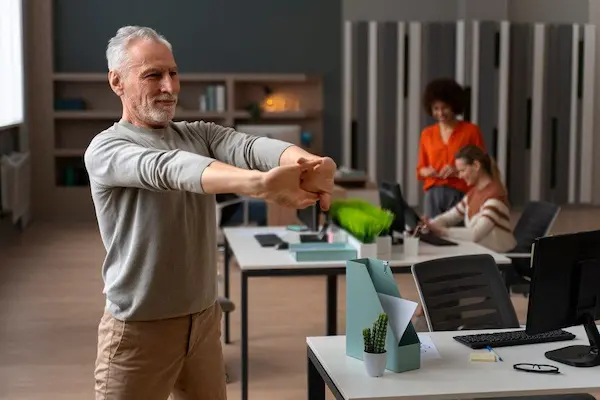
Long hours at a desk can make even a motivated person feel stuck, especially when it seems impossible to leave the workstation for long walks or full gym style breaks.
On many workdays, meetings, deadlines, and messages arrive one after another, leaving only tiny pockets of time that rarely feel big enough for a traditional workout, yet your body still quietly asks for movement.
Desk friendly workout ways at work offer a practical bridge between those two realities, giving you respectful, subtle movements that can be done in normal work clothes and in shared offices without drawing unwanted attention.
Instead of imagining that “exercise” must be sweaty, loud, or obviously sporty, it becomes much more manageable to think in terms of micro routines, discreet office stretches, small chair exercises, and movement breaks that last one to five minutes.
For an office worker who wants to move but cannot leave the desk often, these tiny pieces of activity keep joints happier, circulation steadier, and focus sharper, all while still looking and feeling work appropriate.
Throughout this article, you will find lists of subtle exercises, short routines you can plug between tasks, and simple reminder strategies that integrate movement into emails, calls, and documents instead of competing with them.
Why small movement breaks matter during work
Modern office work looks still from the outside, yet mentally and emotionally it can feel intense and draining, which makes the body’s need for regular movement easy to overlook.
Sitting in the same position for long periods tends to tighten hips, shoulders, and the upper back, while also asking your eyes to focus on a narrow screen space for hours at a time.
Adding gentle desk friendly workout ways at work throughout the day gives your muscles and joints little reminders that they are meant to move, without requiring full outfit changes or a separate workout room.
Short movement breaks also act as mental resets, offering tiny boundaries between tasks so your brain can switch gears from one project to the next more smoothly.
In many offices there is no realistic chance to disappear for thirty minutes several times a day, yet there is often enough space for a thirty second stretch while a file loads or an online meeting connects.
By choosing movements that respect clothing, workspace, and company culture, it becomes possible to support health quietly while still showing full commitment to your professional responsibilities.
Principles for discreet desk friendly workout ways at work
Before exploring specific movement ideas, it helps to define a few simple principles that keep your desk workout subtle, respectful, and easy to maintain even in busy or formal environments.
These principles guide how you select, adapt, and combine office stretches and chair exercises so that they feel natural rather than awkward in a professional context.
- Prefer movements that can be done seated or standing in a small area without drawing eyes from across the room.
- Choose options that require no special equipment, no lying on the floor, and no large arm swings that might disturb neighbors.
- Keep intensity at a level that raises comfort and focus, not sweat and heavy breathing that could feel out of place at work.
- Integrate exercises into natural pauses such as reading long emails, joining calls, or waiting for code, documents, or reports to load.
- Focus on consistency through many small moments rather than perfection in a single long session.
With these guidelines in mind, each desk friendly routine becomes a quiet support for your day rather than a performance or disruption.
Quick posture reset as your foundational desk workout
Posture tends to collapse slowly while concentrating, and often a person notices tension only after a long stretch of focused work has passed.
A simple posture reset routine becomes a foundation for all other desk friendly workout ways at work, because it can be done in only a few breaths whenever you remember.
Thirty second posture reset checklist
This short sequence can be done seated in almost any chair without attracting attention.
- Place both feet flat on the floor, ideally hip width apart, and slide forward or backward until you feel stable and grounded.
- Roll your shoulders gently up, back, and down, allowing your chest to open slightly while keeping the movement smooth and quiet.
- Imagine a string gently lifting the back of your head toward the ceiling, lengthening the back of your neck without forcing your chin upward.
- Relax your jaw and eyebrows, letting your face soften while your spine stays tall and supported.
- Take two slow breaths in through the nose and out through the mouth, feeling the upper body settle comfortably over the hips.
Repeating this posture reset each time you open a new document, join a meeting, or start a fresh task keeps alignment from drifting too far without needing extra time or space.
Desk workout: subtle neck and shoulder office stretches
Neck and shoulders often carry the first signs of desk strain, especially when people lean toward the screen or hold the phone in one position for long periods.
Short, subtle office stretches in this area can be done while looking at the monitor or even while listening in a meeting, making them ideal for a busy office worker.
Neck release sequence for seated work
The following exercises stay small enough to look like natural shifts in posture, yet still provide meaningful relief.
- Side neck tilt
Sit tall, gently let one ear move toward the same side shoulder, pause for a breath or two, then return to center before repeating on the other side.
- Diagonal look down
Turn your chin slightly toward one armpit as if looking at a shirt button, relax the opposite shoulder away from the ear, and breathe slowly for several seconds.
- Gentle head nods
Keep your spine tall and nod your head slightly up and down, as though agreeing with a subtle point, to encourage mobility without dramatic movement.
Shoulder and upper back office stretches
Shoulder tension often builds while typing or using a mouse, and these quick stretches help release it without leaving your chair.
- Shoulder roll set
Roll both shoulders up toward the ears, then back and down, repeating for eight to ten small, smooth circles.
- Across the chest stretch
Bring one arm across your body at chest level, gently support it with the other hand, and hold for several breaths while keeping shoulders relaxed.
- Upper back open and close
Interlace your fingers in front of your chest, reach forward as your upper back rounds slightly, then open your arms wide as if welcoming someone, repeating several times.
These movements can be rotated throughout the day so that neck and shoulders receive regular attention rather than only reacting once discomfort becomes strong.
Chair exercises for core and back support
Sitting for long periods does not have to mean that core muscles sleep all day, because small chair exercises can quietly remind them to participate in holding your posture.
Activating the core in subtle ways supports the lower back and makes long sessions at a desk feel more sustainable.
Seated core engagement sequence
These desk friendly workout ways at work stay invisible to others while still encouraging strength and stability around the spine.
- Breath based core brace
Sit tall with feet flat, breathe in gently, then as you exhale imagine hugging your waist slightly toward your midline without holding your breath, maintaining this light engagement for a few seconds.
- Small seated rotations
Place your hands lightly on your thighs, rotate your upper body a few degrees to one side as if turning to look at a colleague, return to center, then repeat to the other side for eight to ten repetitions.
- Marching core wake up
While seated upright, lift one knee a few centimeters off the floor, lower it, and alternate sides, keeping the belly gently engaged and the movement quiet.
Back friendly chair exercises
Supporting the back with movement helps reduce stiffness that often appears after long stretches of focused work.
- Seated cat and cow
Place your hands on your knees, arch your back gently as you look slightly upward, then reverse the curve so your back rounds a bit and your chin comes toward your chest, repeating slowly for several breaths.
- Diagonal reach
Reach one arm toward a high corner of the room, feeling a long line from hip to fingertips, then switch sides, keeping the motion smooth and comfortable.
Performing a few of these core and back exercises during natural pauses, such as while reading a long email, keeps support muscles quietly involved throughout the workday.
Leg and circulation focused desk workout ideas
Legs and hips can feel heavy or restless after long periods of immobility, yet standing up frequently is not always possible in certain roles or meetings.
Discreet leg movements done sitting down help circulation, wake up muscles, and may reduce that “stuck” feeling many people notice in the afternoon.
Seated leg activation series
The following chair exercises require almost no visible effort, making them ideal for formal settings.
- Heel and toe rock
Keep your heels on the floor and lift your toes several times, then switch by keeping toes down and lifting heels, alternating for thirty to sixty seconds.
- Knee extension taps
Sit tall, extend one leg until the heel gently taps the floor in front of you, bend it back, and alternate sides for eight to twelve repetitions each.
- Inner thigh engagement
Place a folded jacket, notebook, or small bag between your knees, press inward gently for five seconds, and release, repeating several times.
Subtle standing options near the desk
When there is a small moment to stand up, even very short standing movements can offer a refreshing change.
- Desk side calf raises
Stand behind your chair, hold the backrest lightly, rise onto your toes, pause briefly, and lower, repeating for ten to fifteen repetitions.
- Mini hip hinge
With hands resting lightly on the desk, push your hips back a little and lean your torso forward, then return to standing, repeating several times with a relaxed spine.
- Side step shift
Take a small step to one side and then back, repeating for a short set on each leg while staying close to your workspace.
Combining seated and standing leg movements throughout the day helps keep lower body circulation more active even when overall movement options remain limited.
Hand, wrist, and eye care during desk workouts
Keyboard and mouse use place constant demands on hands and wrists, while screens require steady visual focus, making targeted movement breaks particularly valuable in these areas.
Desk friendly workout ways at work are not only about large muscles; gentle care for smaller joints and eyes helps maintain comfort over long work hours.
Office stretches for wrists and hands
These simple stretches can be done quickly without drawing attention.
- Wrist flexor stretch
Extend one arm forward with the palm up, use the other hand to gently pull the fingers downward, and hold for several breaths before switching sides.
- Wrist extensor stretch
Turn the same hand palm down, lightly pull the fingers toward you, and again hold the position briefly on each side.
- Finger spread and fist cycles
Open your hands as wide as possible to spread the fingers, then slowly close into a gentle fist, repeating ten times.
Micro breaks for eyes
Eyes also benefit from regular short pauses, and discreet practices can be included during almost every work hour.
- Distance shift
Look away from your screen toward a distant object for twenty seconds, then back to your work, repeating a few times each hour.
- Blink reset
Close your eyes gently for five seconds, open them, and blink rapidly a few times to refresh moisture on the surface.
- Soft focus scan
Let your gaze soften, scan slowly around the room, and then return to the main task, allowing eye muscles to change their usual pattern.
These small practices protect comfort in hands and eyes, making long work sessions feel more sustainable even when deadlines are demanding.
Short desk workout routines built into the workday
Individual exercises are useful, yet many people find it easier to follow small pre built routines rather than invent combinations on the spot.
By organizing movements into quick sequences that fit natural work pauses, desk friendly workout ways at work become more automatic and easier to repeat.
Sixty second refresh routine
This routine fits into the time it takes for a document to save or for a meeting to start.
- Perform eight slow shoulder rolls while seated upright.
- Complete ten heel and toe rocks with both feet.
- Finish with two deep breaths, lengthening your spine and relaxing your jaw.
Three minute focus reset routine
A slightly longer sequence can act as a divider between major tasks.
- Start with one minute of seated marching, lifting each knee a few centimeters while keeping your posture tall.
- Add one minute of alternating side neck tilts and diagonal look downs for gentle neck release.
- Finish with one minute of seated cat and cow, moving your spine slowly through its comfortable range.
Using these micro routines at predictable times, such as after sending a large report or finishing a call, helps connect movement breaks to work rhythms naturally.
Five minute desk friendly workout for busy days
Some days offer just enough space between meetings to insert a slightly more complete mini workout while still staying close to your desk.
A five minute block can include upper body, lower body, and light core engagement, all in a way that remains subtle enough for an office environment.
Five minute chair exercises combination
The sequence below can be performed once or twice depending on available time.
- One minute posture reset and breathing
Use the posture checklist, then take several slow breaths to signal a short shift from work to movement.
- One minute seated leg activation
Alternate knee extension taps and heel lifts, focusing on smooth, quiet motion.
- One minute upper body office stretches
Cycle through across the chest stretch and upper back open and close movements.
- One minute core engagement
Practice breath based core braces and small seated rotations, keeping hips stable.
- One minute standing option
Stand behind your chair for calf raises and mini hip hinges, then sit back down feeling refreshed.
Even on crowded calendars, this five minute structure can often be tucked between meetings without needing special preparation or a change of clothes.
Movement breaks integrated into everyday tasks
Desk friendly workout ways at work become easier to sustain when they link directly to tasks you already perform rather than relying on entirely separate dedicated slots.
Attaching specific exercises to predictable work actions turns them into quiet habits instead of occasional experiments.
Linking movement to digital tasks
Below are some practical pairings between common computer tasks and simple movement breaks.
- Every time you send a significant email, stand for thirty seconds and perform calf raises while reviewing what you just wrote in your mind.
- Whenever a large file downloads or a report runs, complete a short set of shoulder rolls and neck side tilts before returning to the screen.
- After finishing a long block of typing, practice wrist stretches and finger open and close cycles.
- At the start of each video meeting, take two posture reset breaths while waiting for others to join.
Linking movement to offline moments
Many small offline activities also create natural triggers for brief movement.
- When refilling a water bottle, add ten slow side step shifts near the cooler or kitchen area.
- Each time you return from the printer or another workstation, perform a few seconds of standing hip hinges before sitting down.
- Before picking up the phone for a scheduled call, complete several breath based core braces to reset posture.
Over time these linked actions accumulate into a meaningful amount of low intensity movement without requiring any official “workout” time block.
Using reminders to support office movement breaks
Even with good intentions, busy work can easily absorb attention and cause movement plans to fade into the background.
Gentle reminder systems make desk friendly workout ways at work more reliable without feeling intrusive or disruptive.
Digital reminder ideas
Several simple options can be set up on devices you already use.
- Schedule recurring calendar events labeled “thirty second stretch” at intervals that match your work style, such as every sixty or ninety minutes.
- Use a subtle timer or vibration on a phone or watch to prompt posture resets and quick routines without drawing attention from colleagues.
- Create a checklist at the top of your to do list with a few chosen exercises, and mark them off during the day alongside work tasks.
Physical reminder strategies
Physical cues also help nudge memory throughout the day.
- Place a small sticky note with a simple word like “move” or “posture” on the edge of your monitor.
- Keep a light object, such as a stress ball, near the keyboard to remind you to stretch hands and wrists regularly.
- Arrange your chair slightly farther from the desk so that reaching the keyboard requires sitting upright instead of slumping forward.
With these reminder systems in place, small movement breaks can become as routine as checking messages or opening your calendar.
Adapting desk friendly workout ways to different office cultures
Workplaces differ widely in layout, formality, and expectations, so adapting desk workout habits to match your environment shows respect and increases comfort for both you and your colleagues.
Subtlety becomes especially important in open plan offices, shared workspaces, and client facing roles.
Questions to consider about your environment
Reflecting briefly on your setting helps you choose the most appropriate options.
- Do you sit in a private office, a cubicle, an open floor, or a shared table arrangement, and how visible are you to others during the day.
- How formal is the dress code and atmosphere, and would standing occasionally or performing small stretches be considered normal or unusual.
- Are there brief moments when most people look away, such as while reading documents or during pauses in meetings, that suit micro movements.
- Does your company already encourage wellness practices, which might make visible movement breaks more accepted.
Choosing movements that match your context
Once these questions feel clearer, it becomes easier to tailor your approach.
- In very formal settings, emphasize seated exercises, hand and wrist stretches, eye breaks, and micro core engagement that remain invisible.
- In more relaxed offices, include quiet standing calf raises, side step shifts, and short chair pushes or hip hinges during private moments.
- If you work remotely, feel free to expand your range with larger stretches and more dynamic movements whenever the camera is off or breaks allow.
Aligning movement choices with workplace norms ensures that your desk friendly workout ways at work enhance your day without causing discomfort for anyone around you.
Safety and comfort considerations for desk workouts
Even gentle office stretches and chair exercises involve real movement, so basic safety remains important, particularly when performing them frequently throughout a busy week.
Listening to your body and respecting any limits keeps these helpful routines from becoming an additional source of strain.
Personal safety checklist
This simple list can guide decisions around what to include or modify.
- Stop immediately if any movement causes sharp pain, strong dizziness, or unusual discomfort, and avoid repeating that exercise.
- Modify or skip movements that feel awkward in your specific chair or clothing, especially if stability is affected.
- Maintain clear space for your feet and chair base so that shifting position does not catch on cables or objects under the desk.
- Use the backrest when needed for support, and avoid leaning so far forward or sideways that balance feels uncertain.
Professional guidance and individual needs
Because every person brings a different health history to the workplace, it is important to recognize that these suggestions are general and may not suit every situation.
Anyone with existing medical conditions, significant joint issues, or recent injuries should consult a qualified health professional before adding new movement patterns, even subtle ones, to the day.
In some cases, a physical therapist or occupational health specialist can suggest specific desk friendly variations that better match your body and work setup.
Bringing it all together into sustainable desk movement habits
Small, respectful movement moments add up over time, especially when they are linked to tasks, supported by reminders, and adapted thoughtfully to the culture of your workplace.
Desk friendly workout ways at work are less about extraordinary effort and more about gentle consistency, caring for your body in the same quiet way you care for your inbox and schedule.
By mixing posture resets, neck and shoulder office stretches, subtle chair exercises for core and legs, and brief movement breaks between tasks, each workday gradually becomes more active without looking dramatically different from the outside.
The key is to start small, choose a few favorite ideas, and build from there, adjusting as you notice which routines fit most smoothly into your real day.
Important disclaimer and independence notice
This article shares general information about desk friendly workout ways at work, and nothing here should be interpreted as personalized medical advice, diagnosis, treatment guidance, or a substitute for professional assessment.
If you feel pain, instability, or other concerning symptoms during any desk workout, office stretches, chair exercises, or movement breaks, it is essential to stop the activity and seek advice from a qualified healthcare or fitness professional.
Exercises and routines should always be adapted to your own health status, mobility, comfort level, and workplace environment, and choosing lighter variations or shorter sessions remains a responsible decision whenever uncertainty arises.
The content presented is independent and does not have any affiliation, sponsorship, endorsement, or control from institutions, platforms, employers, brands, or other third parties that might be mentioned in general or descriptive ways.
Names of objects, tools, or workplace situations appear only as neutral examples to illustrate possible scenarios, and there is no commercial or official relationship with them.
Your body, your responsibilities, and your context at work are always central, and these suggestions are intended to offer flexible options that you can adjust, combine, or decline according to your own judgment and professional reality.