

Many people feel uncomfortable or unmotivated in traditional gyms, yet notice that a simple walk in fresh air often leaves them calmer, more energized, and more willing to move a little bit more, which is exactly why outdoor workout ways for beginners can be such a friendly gateway into regular exercise.
Stepping into a park, a quiet street, or a nearby trail means the sky becomes your ceiling and the ground becomes your training space, and instead of machines and mirrors you have trees, benches, open paths, and playground structures that can all support a light park workout built from easy bodyweight outside movements.
Beginning with very straightforward walking routine ideas, adding a few basic bench exercises, and then combining them into short outdoor circuits lets you build strength and stamina gently, while still enjoying sunlight, fresh air, and the sense of freedom that comes from training outside rather than inside four walls.
This guide focuses on clear, easy-to-follow options designed especially for new exercisers who prefer nature over gyms, offering walking plans, park workout templates, bodyweight outside variations, and safety considerations that help you enjoy your sessions comfortably and confidently.
Foundations for Safe and Enjoyable Outdoor Sessions
Essential Safety Considerations Before Any Park Workout
- Comfortable, supportive shoes make every walking routine or light jog safer and more pleasant, so it is worth checking that your footwear fits well, has enough cushioning, and does not rub or pinch after ten or fifteen minutes of continuous movement.
- Surfaces matter more than many people realize, because flat paths, well-maintained sidewalks, or park tracks usually put less stress on joints than uneven stones, steep slopes, or deep sand, therefore beginners should choose relatively smooth routes for their first outdoor workout ways for beginners.
- Weather awareness becomes part of your preparation, which means using sunscreen or a hat under strong sun, bringing an extra layer in cooler temperatures, and avoiding outdoor training in lightning storms, extreme heat, or very icy conditions.
- Hydration plays a role even in gentle sessions, so carrying a small bottle or planning routes that pass by a fountain allows you to sip water occasionally, especially during longer park workout days or warm afternoons.
Listening to Your Body as You Explore New Moves
- Normal sensations during gentle outdoor workout ways for beginners include slightly faster breathing, a feeling of warmth in muscles, and a sense of effort that still allows you to talk in short sentences, which usually signals that intensity is appropriate for a walking routine or light bodyweight session.
- Warning signs you should never ignore include sharp pain, strong chest discomfort, sudden dizziness, or severe shortness of breath, and if any of these appear, stopping immediately, resting, and seeking medical advice if symptoms do not fade is the safest approach.
- Joint discomfort that feels more like pressure or gentle stiffness can sometimes be managed by slowing your pace, shortening your stride, reducing range of motion in bodyweight outside exercises, or shifting to softer surfaces such as grass or park tracks.
- Recovery is part of the process, so checking how you feel the next day and adjusting your next outdoor session accordingly helps your body adapt gradually rather than being overwhelmed by too much too soon.
Beginner Walking Routine Plans: The Easiest Outdoor Workout Starting Point
Why Walking Is a Powerful Foundation
Walking may look simple, yet it remains one of the most accessible and joint-friendly outdoor workout ways for beginners, because it requires no special skills, can be done almost anywhere, and allows you to adjust speed, distance, and terrain to your current fitness level.
- Walking improves circulation and leg strength while still being gentle enough for most people to sustain regularly, making it a practical base for building more complex park workout routines later.
- For many new exercisers, walking outside in fresh air feels less intimidating than structured gym sessions, which increases the chances of staying consistent beyond the first week.
- A walking routine can easily be paired with small bodyweight outside breaks—such as step-ups on a low bench or simple stretches—turning any walk into a more complete outdoor workout.
Four-Week Beginner Walking Routine Example
Someone starting from a mostly sedentary lifestyle can use a gradual four-week plan to avoid doing too much too soon and to build confidence with each week.
- Week 1 – Gentle Introduction
- 3 days per week, choose a flat route and walk for 10 minutes at a comfortable pace.
- Insert a short pause after 5 minutes if needed, using a bench or railing to perform light calf stretches.
- Focus on posture—imagine a string gently lifting your head—and relaxed shoulders rather than speed.
- Week 2 – Extending Time Slightly
- 3–4 days per week, walk 12–15 minutes, keeping the same easy pace most of the time.
- Use the last 2–3 minutes to walk slightly faster, then slow down for the final minute as a cool-down.
- Notice how your legs and breathing adapt, and stop if anything feels uncomfortable.
- Week 3 – Adding Light Intervals
- 4 days per week, walk for 15–18 minutes total.
- Alternate 2 minutes of normal pace with 1 minute of slightly brisk pace, repeating this pattern four or five times.
- Stay on mostly flat surfaces and continue to pay attention to how your joints feel.
- Week 4 – Building Confidence
- 4–5 days per week, walk 18–20 minutes.
- Include 3–4 short brisk intervals of 2 minutes each, with 2 minutes of comfortable walking between them.
- Optionally explore gentle slopes in your park workout route while maintaining control on the way down to protect knees.
After finishing this simple progression, many beginners feel ready to maintain a similar walking routine or to add more structured bodyweight outside exercises along their route.
Warm-Up and Cool-Down Ideas for Outdoor Sessions
Quick Outdoor Warm-Up Sequence (5 Minutes)
- 1 minute – Easy walk or march: Begin moving with low intensity, swinging arms and stepping gently to raise body temperature.
- 1–2 minutes – Joint preparation: Perform slow ankle circles, knee bends, and hip circles while standing next to a bench or railing for balance.
- 1–2 minutes – Dynamic upper body moves: Add arm circles, gentle torso rotations, and small side bends to wake up shoulders and spine.
Simple Cool-Down Stretch Flow (3–5 Minutes)
- After your outdoor workout ways for beginners, reduce pace gradually for one to two minutes until your breathing returns closer to normal.
- Stretch your calves by stepping one foot back, pressing the heel toward the ground, and leaning slightly into a wall or bench.
- Gently stretch the front of the thighs by holding onto a railing and drawing one heel toward your glute, keeping knees close together.
- Finish with a light chest and shoulder stretch by placing hands on a tree or fence and leaning forward slightly, holding each stretch for 15–20 seconds.
These small warm-up and cool-down habits support joint health and make each park workout feel more complete and comfortable.
Using Park Benches for Beginner-Friendly Strength Work
Why Benches Are Great Tools for Bodyweight Outside Training
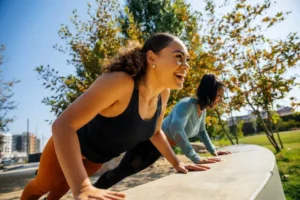
Park benches offer a stable, elevated surface that can turn into an outdoor gym for beginners, because many fundamental strength movements become easier and safer when hands or feet are raised slightly off the ground.
- Incline positions such as hands-on-bench push-ups reduce the load on your arms and shoulders compared to floor versions, making them ideal for new exercisers.
- Benches provide support for step-ups, split squats, and seated exercises, allowing you to guide depth and range of motion carefully.
- Sturdy benches with backs can help with balance during certain movements, giving you a sense of security as you explore different outdoor workout ways for beginners.
Bench Exercise Library for Beginners
- Bench Squat (Sit-to-Stand)
- Stand in front of the bench with feet about hip-width apart and toes slightly pointed outward.
- Lower your hips back toward the bench under control until you lightly touch or sit, then press through your heels to stand up tall again.
- Focus on keeping your knees aligned with the middle of your feet and your chest gently lifted.
- Step-Up
- Place one foot firmly on the bench, keeping the entire foot supported, and hold a railing or backrest if available for balance.
- Press through the elevated foot to bring your body upward, lightly tap the other foot on the bench, then step back down.
- Repeat for several repetitions on one side before switching legs, always using height that feels safe and stable.
- Incline Push-Up
- Place both hands on the edge of the bench, slightly wider than shoulder-width, and walk your feet back until your body forms a straight line.
- Bend elbows to lower your chest toward the bench, then push back to the starting position while maintaining core engagement.
- Control the movement rather than bouncing, and adjust foot position to change the difficulty.
- Bench Hip Bridge (Upper Back on Bench)
- Sit on the bench and slide downward until your shoulder blades are resting on the edge and feet are flat on the ground.
- Drop hips slightly, then press them upward to form a straight line from shoulders to knees, squeezing the glutes at the top.
- Lower hips again with control, repeating gently and avoiding excessive arching of the lower back.
These park workout bench exercises can be inserted between walking intervals or grouped into short strength circuits for a complete outdoor session.
Bodyweight Outside Circuits: Combining Walking and Strength
15-Minute Park Circuit for Complete Beginners
New exercisers who want a structured outdoor workout way for beginners can use this short circuit that alternates walking and gentle strength moves using a bench.
- Warm-up walk (4 minutes)
- Start with an easy walking routine around the park, gradually increasing pace until you feel lightly warmed.
- Strength and walk circuit (9 minutes total)
- Block 1:
- Bench squats – 8 to 10 repetitions.
- Incline push-ups on bench – 6 to 8 repetitions.
- Walk for 2 minutes at a comfortable pace.
- Block 2:
- Step-ups – 6 to 8 repetitions per leg.
- Bird-dog style balance (standing, holding bench) – 6 repetitions per side.
- Walk for another 2 minutes, breathing calmly.
- Block 1:
- Cool-down stroll (2 minutes)
- Reduce pace and add a few gentle stretches before leaving the park.
Following this pattern two or three times per week allows your body to adapt steadily while keeping sessions short and nature-friendly.
25-Minute Walking and Strength Park Workout
Once the shorter circuit feels comfortable, a slightly longer plan gives space to practice more repetitions and perhaps explore varied paths.
- Phase 1 – Walking routine (8 minutes): Walk at an easy to moderate pace, including 2–3 short periods of slightly brisk walking for 60 seconds each.
- Phase 2 – Strength block (12 minutes):
- Complete the following 3 rounds with 60–90 seconds of gentle walking between rounds:
- Bench squats – 10 repetitions.
- Incline push-ups – 8 to 10 repetitions.
- Step-ups – 8 repetitions per leg.
- Bench hip bridges – 10 to 12 repetitions.
- Complete the following 3 rounds with 60–90 seconds of gentle walking between rounds:
- Phase 3 – Cool-down and reflection (5 minutes): Walk slowly, stretch calves and hips, and take note of how your body and mood feel compared to before the outdoor workout.
Training this way turns a modest amount of time into a full park workout that supports both cardiovascular health and basic strength using nothing but your bodyweight and a bench.
Playing With Playground Structures for Fun Bodyweight Training
Simple Movements Using Rails and Bars
Playgrounds and fitness stations in parks often contain low rails, bars, or climbing frames that can become excellent supports for bodyweight outside exercises, as long as you choose stable structures and move with control.
- Assisted row on low bar:
- Hold a bar that is around waist height or lower, walk your feet forward, and lean back with straight arms.
- Pull your chest toward the bar by bending elbows and squeezing shoulder blades, then lower slowly.
- Incline plank on bar:
- Place hands on a rail or low bar, walk feet backward, and hold a stable plank position while breathing steadily.
- Focus on a straight line from head to heels, avoiding sagging hips.
- Step-over drills:
- Use a very low bar or line and step one foot over at a time, then back, practicing coordination and hip mobility.
- Keep movements low and controlled to reduce any risk of catching your foot.
These playful options keep an outdoor workout interesting and can be mixed with walking routine segments and bench exercises for more variety.
Adapting Outdoor Workouts to Different Fitness Levels
Adjustments for Very New or Nervous Exercisers
- Shorten total time by beginning with 10–15 minutes of movement, counting all walking and gentle stretching as valid training while your body adapts.
- Reduce the number of repetitions for strength moves and prioritize consistent, comfortable form over the desire to match any suggested numbers exactly.
- Use flatter routes and lower bench heights, and avoid uneven ground until your balance and leg strength improve.
Adjustments for People Who Already Walk Often
- Use walking time primarily as a warm-up and cool-down, then spend more minutes on structured bodyweight outside circuits with benches or playground equipment.
- Add short hill segments or gentle intervals into your park workout plan by walking briskly uphill and recovering on flatter stretches.
- Increase total session time gradually to 30–40 minutes if your schedule and body both feel comfortable with that progression.
Adjusting intensity, duration, and terrain in this way helps outdoor workout ways for beginners grow with you as your confidence and conditioning improve.
Building a Long-Term Habit Around Nature and Movement
Making Outdoor Sessions Part of Your Weekly Rhythm
- Choosing specific days and approximate times for your park workout—such as early mornings on weekdays or late afternoons on weekends—turns exercise into an appointment with yourself rather than a last-minute decision.
- Keeping your walking shoes, lightweight layers, and a small water bottle ready near the door removes friction when it is time to head outside.
- Using simple journals or calendar marks to track how many outdoor workouts you complete each week offers gentle accountability and evidence of progress.
Weather and Backup Plans
- Recognizing that outdoor workout ways for beginners depend on weather means having indoor alternatives ready, such as simple living room marching or staircase routines, for very rainy or icy days.
- Choosing partly covered areas, like tree-lined paths or shelters, can allow shorter sessions even when conditions are not perfect.
- Accepting that some days will require rest or modified movement keeps your approach flexible and kind rather than rigid and stressful.
Final Thoughts: Enjoying Fresh Air While You Build Strength and Confidence
Training does not have to live exclusively inside gyms or follow complicated programs to be meaningful, and for many new exercisers, outdoor workout ways for beginners turn out to be the most enjoyable and sustainable path into movement because the focus stays on fresh air, simple walking routines, and bodyweight outside exercises that feel achievable in everyday clothes.
Park workout ideas that incorporate benches, rails, gentle circuits, and walking paths invite you to view ordinary public spaces as supportive environments for your health rather than places you just pass through on the way to somewhere else.
Every time you complete a short walk, try a new bench movement, or finish a small park circuit, you reinforce the belief that your body can move in nature, at your pace, and in ways that fit both your current fitness level and your long-term goals.
Over weeks and months, these small choices accumulate, creating a new normal where outdoor movement feels less like a chore and more like a refreshing part of your routine, allowing you to enjoy the benefits of fresh air, stronger muscles, better stamina, and a clearer mind—all built from simple, welcoming outdoor workout ways for beginners.